 |
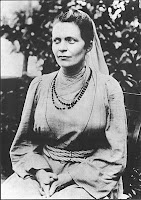
Sister Nivedita |
“Mother Teresa was not a friend of the poor. She was a friend of poverty. She said that suffering was a gift from God. She spent her life opposing the only known cure for poverty, which is the empowerment of women and the emancipation of them from a livestock version of compulsory reproduction. And she was a friend to the worst of the rich, taking misappropriated money from the atrocious Duvalier family in Haiti (whose rule she praised in return) and from Charles Keating of the Lincoln Savings and Loan.
“Where did that money, and all the other donations, go? The primitive hospice in Calcutta was as run down when she died as it always had been—she preferred California clinics when she got sick herself—and her order always refused to publish any audit. But we have her own claim that she opened 500 convents in more than a hundred countries, all bearing the name of her own order. Excuse me, but this is modesty and humility?”
~ Christopher Hitchens in his October 2003 essay, “
Mommie Dearest.” He wrote this essay to express his outrage at Pope John Paul II’s 2003 proclamation to beatify Mother Teresa.
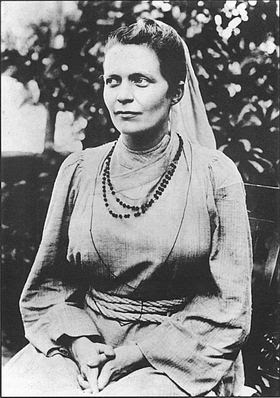
Hitchens could not have leveled similar charges against Sister Nivedita, another European lady who made India her home. Born in Ireland in 1867, Nivedita’s original name was Margaret Elizabeth Noble. After a fateful encounter with Swami Vivekananda in 1895 in London, she decided to come to India and live here permanently. She left England in 1897 and reached Calcutta on January 28, 1898. On March 25, Vivekananda gave her the name Nivedita, which means “dedicated to the Lord.”
Intellectually and morally, Nivedita was the exact opposite of Mother Teresa. She did not enshrine poverty, as Mother Teresa did. She did not glorify suffering, as Mother Teresa did. She wanted India to be a prosperous and free country. She did not suspect modern education as Mother Teresa did; she wanted all Indians to develop the knowledge of their history, culture, and religious traditions. She never collected donations from dubious sources and she despised tyrants. She did not try to promote herself as a saint—quietly and with great efficiency, she did the work of providing education to girls of Bengal who were denied even basic education.
She made a deep study of Indian literature and history, and after Vivekananda’s death in 1902, she emerged as an important thinker and leader of Indian nationalism. Through her writings and speeches she tried to encourage the Hindus to believe in a common nationhood and common destiny. She collaborated with the prominent Indian intellectuals and nationalists of her time: Romesh Chandra Dutt, Bipin Chandra Pal, Jagdish Chandra Bose, Sri Aurobindo, Rabindra Nath Tagore, and Jadunath Sarkar were among her personal friends and associates.
Due to hard work and illness, she died in 1911, at the age of 44. She left behind extensive writing on Indian philosophy, religion, literature, art, history, and mythology. In 1967, her writings and speeches were compiled and published in five volumes (each of about 600 pages), by Ramakrishna Sarada Mission and Sister Nivedita Girls' School, under the title, The Complete Works of Sister Nivedita, Volume 1 to V. Her uncritical and sentimental attachment to India and to the Hindu way of life is visible in most of her essays.
Here’s an excerpt from her essay, “The Crown of Hinduism” (The Complete Works of Sister Nivedita, Volume 3, Page 396):
"Perhaps the real crown of Hinduism lies in the fact that it, almost alone amongst formulated faiths, has a section devoted to absolute and universal truths, and has no fear whatever of discriminating between these and those accidental expressions which might be confounded bv the superficial with their belief itself… There is no shade of the search after truth that is not looked upon here as religious heroism. We are in no danger of persecuting a man for no better reason than that he can see farther and deeper than we! Giordano Burno would never have been burnt, Galileo would never have been put to the torture, if India had been their home and birthplace."
Here’s an excerpt from her essay, “A Theory of Freedom” (The Complete Works of Sister Nivedita, Volume 4, Page 316):
“There are two ways in which freedom of any kind can be manifested when it is present. These are renunciation and conquest. That which we would conquer, we must first understand. We have to enter into it, to wrestle with it on given terms, to offer our very lives to it and at last to win the victory. Every success has cost at least one human sacrifice. Mastery is a kind of freedom. We cannot defeat that which has us in its power…
“…The true criminal is steeped in Tamas and egotism. He miscalls license by the name of liberty. License is not liberty for the simple reason that true liberty presupposes mastery. The profligate is the victim of his own vices. He lies helpless at their feet. He does not even enjoy his appetites. His life is spent like that of wild animal between ungovernable desire and ungovernable fear. He who would be free must first learn to govern. One who is uncontrolled is anything but free.”
.jpg)




.jpg)


.jpg)
,_signed_image_for_Walter_Nash_(NZ_Prime_Minister),_1958_(16017609534).jpg)
